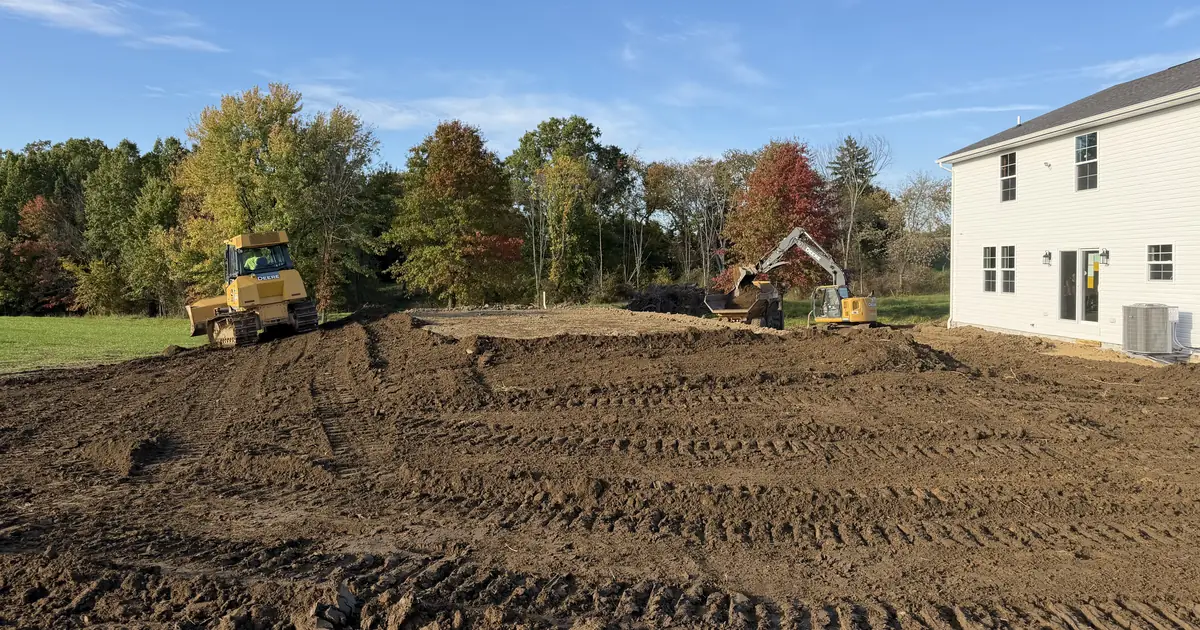
Before a foundation can be dug or a pad can be built, the lot has to be ready. Good site preparation is mostly planning and sequencing, and it is the part of a project that is easiest to get wrong when everyone is eager to break ground. Here is a checklist we would want anyone to run through before the excavation starts on a new lot in Western Pennsylvania.
1. Know Where the Buried Lines Are
Call 811 at least three business days before you dig. Utility companies will mark the lines they own. Marking does not show private lines, such as a buried line to an outbuilding or an old well line, so tell your excavator about anything you know of on the property.
2. Confirm Your Permits and Erosion Controls
New construction usually needs permits, and disturbing a lot of ground can bring erosion and sediment control requirements in Pennsylvania. Your township and your county conservation district can tell you what applies to your project. If erosion controls like silt fence or a stabilized entrance are required, they need to go in before earthwork starts, not after the first rain.
3. Mark the Building Footprint and Limits of Work
Staking the corners of the house, garage or pole barn, and marking how far clearing and grading should go, keeps everyone aligned. It also protects trees and areas you want to keep. Be clear about what stays.
4. Plan Access
Heavy trucks need a stable way onto the lot. A stone entrance keeps mud off the road and gives trucks something solid to drive on. If your driveway is going in later, think about where it will end up, because the construction entrance often becomes the start of it.
5. Clear the Lot
Trees, brush, stumps and debris are removed from the work area. Decide what happens to the material, whether it is chipped, hauled off or piled. If you are keeping trees near the building area, mark them so they are protected during the work. See our land clearing page for more.
6. Strip and Save the Topsoil
Topsoil is valuable. Stripping it from the building area and stockpiling it to the side means you can spread it back during final grading, instead of buying it later. Keep the pile out of the way of drainage and out of the building footprint.
7. Think About Water
Water is what causes most site problems. Look at where it runs now, and where it will run once the house, driveway and roof are in place. Grading should direct water away from the building and not toward a neighbor. For more complex sites, stormwater piping or basins may be part of the plan.
8. Rough Grade the Pad
The building pad is cut and filled to the right elevation. Fill needs to be placed in layers and compacted, since a pad that settles later is expensive to fix. Stone is added where the plans call for it.
9. Plan Utilities Early
Water, sewer or septic, electric and gas all have to reach the building. Trenching these before the final grade is easier than digging up finished work. If the lot is not on public sewer, the septic system design affects where everything else goes.
10. Respect the Weather
Wet soil cannot be moved well, and frozen ground limits what can be done. Build some cushion into your schedule. We will tell you plainly what current conditions mean for the work.
Let One Crew Handle the Sequence
Valley Brook Services handles site preparation, grading, utilities and foundations, and hauls stone with our own trucks. That keeps the sequence tight and the handoffs simple. Tell us about your lot, and see the counties we serve in Western Pennsylvania and Northeast Ohio.